Editor’s Note: Happy Thanksgiving from the Media Consortium! This week, we aren’t stopping The Audit, The Pulse, The Diaspora, or The Mulch, but we are taking a bit of a break. Expect shorter blog posts, and The Diaspora and The Mulch will be posted on Wednesday afternoon, instead of their usual Thursday and Friday postings. We’ll return to our normal schedule next week.
by Lindsay Beyerstein, Media Consortium blogger
Wednesday is the heaviest travel day of the year in the United States, as millions of Americans head home to celebrate Thanksgiving. Some of you are probably reading this dispatch on PDAs as you wait in an interminable line at airport security. Here’s some food for thought.
At Grist, food writer Michael Pollan officially declares himself a Rules Guy. Don’t worry, that doesn’t mean he won’t accept a Friday dinner invitation offered after noon on Wednesday. Pollan thinks that our healthy eating skills are passed down to us as part of food culture. In this era of drive-through windows and meal replacement bars, a lot of the old wisdom is falling by the wayside and Americans are finding themselves adrift in a sea of calories. On the eve of Thanksgiving, Pollan provides some helpful guidelines for avoiding the food coma:
[M]any ethnic traditions have their own memorable expressions for what amounts to the same recommendation. Many cultures, for examples, have grappled with the problem of food abundance and come up with different ways of proposing we stop eating before we’re completely full: the Japanese say “hara hachi bu” (“Eat until you are 4/5 full”); Germans advise eaters to “tie off the sack before it’s full.” And the prophet Mohammed recommended that a full belly should contain one-third food, one-third drink, and one-third air. My own Russian-Jewish grandfather used to say at the end of every meal, “I always like to leave the table a little bit hungry.”
But wait, there’s more!
Unions representing airline pilots and flight attendants are advising their members to avoid the the TSA’s new backscatter x-ray scans because of concerns about the long-term health effects of x-ray radiation. Crew members who refused scans have been subjected to new “enhanced” pat-down searches. This week, the TSA granted an exception to pilots, but not to flight attendants. As I reported for Working In These Times, all crew members go through the same FBI background check and fingerprinting process. “Don’t touch my junk!” has become a rallying cry for passengers, particularly white men, who are not accustomed to being asked to give up any part of their body’s autonomy for the greater good. Is it a coincidence that 95% of pilots are men and three-quarters of flight attendants are women? [Update: The TSA has relented. The agency announced Tuesday that flight attendants will now get the same exemption as pilots.
Adam Serwer argues in The American Prospect that it’s easy to demand tough security measures when the presumed targets are faceless Muslims in a distant country. When air travelers are asked to compromise their own privacy in the name of security, the tradeoff suddenly seems very different.
Employee health insurance deductibles are skyrocketing at Whole Foods and CEO John Mackey is trying to blame the increase on health care reform. “This is very important for everyone to understand: 100% of the increases in deductibles and out-of-pocket maximums in 2011 compared to 2010 are due to new federal mandates and regulations,” Mackey wrote in a corporate memo. In fact, as Josh Harkinson reports in Mother Jones, Mackey’s memo is pure, organic BS. The provisions in the Affordable Care Act that might increase costs won’t go into effect until 2014, so it’s hard to figure out how federal policies could be responsible. Health insurance costs were rising by about 5% per year, year after year, before the Affordable Care Act passed. The truth is that health insurance is getting more expensive because health care is getting more expensive. As Harkinson points out, one of the reasons that health care is getting more expensive is because corporations like Whole Foods are pushing more of their employees into part-time work to avoid covering them. Of course, when those workers get sick, someone has to pick up the cost of their care. So those who have insurance, including some of Whole Foods’ own employees, have to pay more to make up the difference.
This post features links to the best independent, progressive reporting about health care by members of The Media Consortium. It is free to reprint. Visit the Pulse for a complete list of articles on health care reform, or follow us on Twitter. And for the best progressive reporting on critical economy, environment, health care and immigration issues, check out The Audit, The Mulch, and The Diaspora. This is a project of The Media Consortium, a network of leading independent media outlets.
I apologize. My belly, my bloated body, only belatedly do I understand. It never was in the genes. The abundant meat that weighed heavily on my bones was not caused by my chromosomal structure; it was piled on by Congressional and corporately funded campaigns. Mommy and the husband who helped make me, much to my embarrassment, today I acknowledge my error. I was spoon-fed, and not by the two of you. Legislators, Lobbyists, and big businesses that place misleading labels on chemically cooked up cuisines put corn fillers on my every plate. I chowed down. My little body bulged out. From the inside out, I grew bigger and wider.
Bio: Raj Patel has degrees from the University of Oxford, the London School of Economics and Cornell University, has worked for the World Bank and WTO, and protested against them around the world. He has testified about the causes of the global food crisis to the US House Financial Services Committee and is an Advisor to the United Nations Special Rapporteur on the Right to Food. In addition to numerous scholarly publications, he regularly writes for The Guardian, and has contributed to the LA Times, NYTimes.com, The San Francisco Chronicle, The Mail on Sunday, and The Observer. He is the author of Stuffed and Starved: The Hidden Battle for the World Food System and most recently, The Value of Nothing.
Can you please explain the concept of food sovereignty, and what policies and programs will help encourage it?
Food sovereignty is about communities’, states’ and unions’ rights to shape their own food and agricultural policy. Now that may sound like a whole lot of nothing, because you’re actually not making a policy demand, you’re just saying that people need to be able to make their own decisions. But, actually, that’s a huge thing. Because in general, particularly for smaller farmers in developing countries, and particularly for women, decisions about food and agricultural policy have never been made by them. They’ve always been imposed.
That’s why La Via Campesina, the organization that really invented the term, says that one of the visions behind food sovereignty is that food sovereignty is about an end to all forms of violence against women. That may sound something not at all to do with food, but of course, if we’re serious about people being able to make choices about how their food comes to them and what the food system looks like, then the physical and the structural violence to which women are exposed in the home, in the economy and in society, all need to be tackled. Otherwise we will continue with a situation in which 60 percent of the people going hungry today are women or girls. So food sovereignty, to boil it down, is really about power – who has it in the food system, and how to redistribute it so that those who have concentrated it, have it taken away from them.
In terms of specific policies, what Via Campesina are calling for is for agriculture to be removed from the World Trade Organization, which is a way again in which local countries’ sovereignty is already been given away. They also call for large corporations to be booted out of agriculture. There’s strong opposition to Monsanto for example, and the way that they’ve been behaving in many developing countries, and many Via Campesina members are campaigning against Monsanto in their home countries.
Will another Green Revolution or more food subsidies help reduce hunger?
To answer the question, let’s look at Malawi. It’s the poster child for what a new green revolution in Africa might look like, with widespread subsidies of inorganic fertilizer for farmers. When I went there, late last year, what you found was long lines at the gasoline pump, because all Malawi’s foreign exchange had been spent on importing this fossil fuel-based fertilizer. The country had bankrupted itself in order that it might be a showcase for the new green revolution in Africa. And of course, there are alternatives right there in Malawi, driven by farmers – invariably by women who are innovating around sustainable systems like poly-culture – growing lots of crops simultaneously together, building soil fertility for the long run.
What this shows is that there are some basic incompatibilities between varieties of ways of addressing agrarian problems in Africa. Some organizations, Worldwatch included, adopt a ‘big tent’ approach, in which solutions that keep the status quo but improve it marginally sit alongside far more radical approaches. Ultimately, you can’t promote genetically modified monoculture or techniques that make large-scale commercial farming less destructive at the same time as wanting something like food sovereignty, which calls for much more of a deeper structural rethink of the way the food system operates. Food sovereignty is about democracy in our food system so that everyone gets to eat – industrial agriculture involves a food system run by technocrats for profit. At the end of the day, you can have one or the other -not both.
How does global agricultural policy affect small-scale farmers across the world?
In general the policies foisted on developing countries through organizations like the World Bank is that large scale agriculture is the way to go: that small farmers are a relic of the past. They are of purely cultural significance but economically, socially, and agriculturally, they stand in the way of development. So the policies that are essentially designed to increase farm size and kick off rural populations to the cities are ones that you see in pretty much every country around the world. And yet of course, it is the poor in rural communities that are being forced to bear the brunt of these policies and these are the communities that are least able to afford it. And again – you can never say it too often – it is on women’s shoulders that the bulk of the pain of moving from agrarian society to a so-called modern industrial society one, falls.
Thanks to Dr. Soul Shava, Training Manager at the Aurecon Training Academy, in Pretoria, South Africa for sharing a recent study, by researchers from Rhodes and Cornell Universities and the Sebakwe Black Rhino Conservation Trust, on indigenous crops with the Nourishing the Planet project. We encourage everyone to continue to send in suggestions for examples of, and writing about, environmentally sustainable agriculture innovations to [email protected]. Your input is helping to shape our research! Written by Ronit Ridberg and cross posted from Nourishing the Planet.
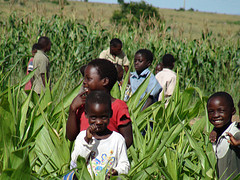
A recent study by researchers from Rhodes and Cornell Universities and the Sebakwe Black Rhino Conservation Trust found that traditional food crops, such as mubovora (pumpkin) and ipwa (sweet reed), are an important source of community resilience in Zimbabwe-including resilience to climate change and economic turbulence.
Unlike traditional crops, the majority of commercial crops that have been introduced to the region “are not adapted to local conditions and require high inputs of agrochemical inputs such as fertilizers, mechanization, and water supply,” according to the study. These crops tend to be more vulnerable to climatic changes, such as the drought and subsequent flooding that occurred in Zimbabwe’s Sebakwe area in 2007-08.
To avoid some of these challenges, many communities and farmers turned-and returned-to growing traditional and indigenous crops. By incorporating indigenous vegetables and increasing crop diversity, farmers improved their diets and increased agricultural resilience to pest, diseases, and changes in weather. Planting different varieties of maize and millet also enabled farmers to match specific crops to their own microclimates.
Additional benefits of growing more diverse crops include seed saving and the processing of traditional foods. With dried and other preserved traditional foods, communities have a more secure and reliable food source during the off-seasons. And seed saving and sharing enable communities to remain independent from commercial agricultural companies, helping to ensure future food security.
For more on the benefits of growing indigenous vegetables as crops, see Innovation of the Week: Homegrown Solutions to Alleviating Hunger and Poverty, Keeping Weeds for Nutrition and Taste, and Creating a Well-Rounded Food Revolution.
Thank you for reading! If you enjoy our diary every day we invite you to get involved: 1. Comment on our daily posts-we check comments everyday and look forward to a regular ongoing discussion with you. 2. Receive weekly updates-Sign up for our “Nourishing the Planet” weekly newsletter at the blog by clicking here and receive regular blog and travel updates.
As you gobble that fine food, be it steak, a frankfurter, roasted chicken, or an omelet, please, sit back relax. Put your feet up and stay a while. I will furnish the entertainment in the form of a film. Meatrix is fun, fascinating, and far from folly. This presentation is playful; the message profound.
You may recall the fairy tales you loved as a child. The plots varied, although all had elements of mystery. Adventures were abundant. Tots were often so engrossed in the tales, they barely noticed that the themes taught a life lesson. Meatrix is as the fables you once anxiously awaited and even asked others to read aloud to you.
Cross posted from Worldwatch Institute’s Nourishing the Planet.
As Iceland’s erupting volcano strands thousands of air travelers across Europe and worldwide, a less publicized but arguably more costly catastrophe is mounting 15,000 miles away: piles of gourmet produce and cut flowers, some of Kenya’s chief exports, are rotting in limbo. Meant to be shipped to upscale grocery stores throughout Europe, lilies, roses, carnations, carrots, onions, baby sweet corn, and sugar snap peas are going bad in heaps, on the vine, and in the ground because airport warehouses are already full and there’s no local market for the expensive produce in a country where half the population lives on less than a dollar a day.
As food prices continue to rise worldwide, reducing food waste will be a critical element in alleviating hunger and poverty worldwide. Already, Nourishing the Planet has highlighted the many ways that growing indigenous vegetables for local markets and improving storage techniques can help to both reduce food waste and improve access to food, in Kenya and elsewhere in sub-Saharan Africa.
To read more about food waste and ways it can be prevented, see: Reducing Food Waste, Finding Creative Ways to Grow Food in Kibera, Farming on the Urban Fringe, and Investing in Better Food Storage in Africa. Also, stay tuned for an entire chapter on the subject, written by Tristram Stuart, in State of the World 2011: Innovations that Nourish the Planet.
Thank you for reading! If you enjoy our diary every day we invite you to get involved: 1. Comment on our daily posts-we check comments everyday and look forward to a regular ongoing discussion with you. 2. Receive weekly updates-Sign up for our “Nourishing the Planet” weekly newsletter at the blog by clicking here and receive regular blog and travel updates.
“Meet the Nourishing the Planet Advisory Group” is a new regular series where we profile advisors of the Nourishing the Planet project. This week, we’re featuring Shayna Bailey, who is Director of International Development for Slow Food International.”
Bio: Shayna Bailey is Director of International Development for Slow Food International. She works on organizational development, strategic partnerships, and resource mobilization at Slow Food’s international headquarters in Italy. She has a M.A. in Sustainable Development and a B.A. in International Business, and has worked on and managed Community-Supported Agriculture programs in the U.S. states of California, Georgia, Pennsylvania, and Vermont, as well as in St. Croix. Bailey has researched perceptions of food security with Quichua women in the Ecuadorian Andes and has studied ecological horticulture at the Center for Agroecology and Sustainable Food Systems at the University of California-Santa Cruz. She represents Slow Food in the Indigenous Partnership for Agrobiodiversity and Food Sovereignty and is involved in planning the 4th meeting of Terra Madre – World Meeting of Food Communities, to be held in October 2010.
On Nourishing the Planet: Nourishing the Planet is an important opportunity to show the world that there are effective alternatives to solving the problems of hunger and poverty that are already in practice, and are replicable on a larger scale. Many of these innovations are not well known to diverse and international audiences. This project gives visibility to lesser-known sustainable approaches that tackle some of the most critical and complex issues of our time. Nourishing the Planet will surely shift policymakers’, development workers’, and ordinary citizens’ perspectives on what it will take to decrease hunger and poverty in sub-Saharan Africa.
In the past few years, the economic relationship between the United States and China has changed dramatically. As Tim Fernholz writes in the American Prospect: “Chastened U.S. officials who once lectured their counterparts in [China] on financial liberalization are now humbled in front of their largest creditor, reduced to offering promises of fiscal responsibility.” It’s a strange state of affairs. Fernholz rightly argues that:
“The common interest of the peoples, rather than the economic elite, ought to be the driving motivation behind the two countries’ interactions. There is no doubt that economic openness has brought wealth to both countries, and the Obama administration is happy to laud the Chinese for bringing millions out of poverty. But in a relationship between “capitalism with American characteristics” and “socialism with Chinese characteristics,” sometimes the people-whether they be workers losing jobs in the United States or the millions of Chinese living without political freedom or prosperity-have interests other than the elites. Today, we’re in an economic crisis, and pragmatism overrides all else. But as recovery continues, the U.S. will require more thought on the strategic track, and perhaps in a few years our discussions with China, as they should be with all our friends, will be more frank.”
But our current economic relationship with China pre-dates President Obama’s “talk first” style of diplomacy. As Robert Scheer of The Nation writes: “Don’t blame any of this on peacenik liberals. The new conciliatory-nay, deferential-tone toward China precedes the Obama administration, having begun in bilateral talks during the last years of the Bush administration as the U.S. economy began its ignominious downfall. It was George W. Bush’s treasury secretary, Henry Paulson, who set the course when the former Goldman Sachs chairman realized how dependent were his Wall Street buddies on Chinese goodwill.”
Strange relations with China aside, things aren’t going so well at home. Rick Wolff, an economist from the New School, says the stimulus package has big problems in a discussion with The Real News. Wolff also notes that we shouldn’t take Wall Street chatter about an economic upswing too seriously. “I think the first thing to remember is the people who are celebrating where we are now are the same people who could not imagine, did not imagine, did not foresee the problem we had last year,” Wolff says.
But what’s going on with our favorite bailout recipients? Talking Points Memo takes on the case of former Federal Pension Guarantor Charles Millard, who exploited his personal ties with employees at BlackRock Capital and Goldman Sachs while choosing firms to manage the Pension Benefit Guaranty Corporation. At this point, both firms “may have run afoul of federal contracting rules in how they courted Millard.”
Goldman Sachs and BlackRock are also on the lookout for the next big economic bubble. Salon reveals that both firms are diversifying their portfolios to include agriculture, in addition to government contracts. “Food is becoming the new oil,” especially since the world’s population is expected to crest nine billion by 2050. And a lot of land is necessary to grow enough food for nine billion people. Phillipe Heilberg, founder of American investment firm Jarch Capital, is hedging his bets on farmland in distressed countries. “Instead of buying stocks, the former banker is now speculating on the political future of South Sudan, which he insists will be an independent country in 10 years, at which point land will be far more expensive than it is today.”
It’s abundantly clear that we can’t rely on the economic elite to represent the people’s interests. Tomorrow’s economic structure must be drastically different if the United States is going to thrive. Put simply, we’re going to have to seriously reevaluate our economic priorities and decide who calls the shots. Here’s hoping that everyday people have a say.
Factory food sickens humans, livestock and the environment
What we eat has changed more in the last 50 years than in the last 10,000. So asserts Robert Kenner’s new film, FOOD, Inc., which opens nationwide June 19th. The vast bulk of food production is now controlled by just a few mega-corporations with one value: profit. Relying on genetic engineering, pesticides and antibiotics, factory food is cheap, requiring little land. But the external costs to our health, the environment and the natural food industry are enormous.
Director: Robert Kenner
Producers: Robert Kenner and Elise Pearlstein
Co-Producer: Eric Schlosser
Released by Magnolia Pictures, with Participant Media and River Road Entertainment
93 minutes
FOOD, Inc. is the single most important film of the decade. Transcending hype and industry muzzling, the film exposes some of the cruel and unnatural aspects of industrial farms and food processing. It links epidemic rates of US obesity and diabetes with our intake of genetically engineered food.
NPR called it this summer’s “suspense thriller.”
The film condemns how workers and animals are abused. Illegal immigrants, who cannot complain about working conditions, comprise most of the workers at industrial food plants. They are vulnerable to raids and deportation. No corporate executives are arrested.
Well researched and well scored, the film debunks the pastoral fantasy spin. Industrial food is not grown, raised or processed on a farm. The animals see no sunshine, are kept immobile in cages, and are genetically or chemically modified. Those that are somewhat mobile are bioengineered to plump their bodies faster than their bones and muscles can support. They flop helplessly to the floor when trying to move.
Read the full review, with images, at http://snipurl.com/k4s6d
Eating Liberally Food For Thought
by Kerry Trueman Originally published on AlterNet; Painting by James Howard Kunstler
I grew up in Woodland Hills, Calif., a nominally pastoral, petrocentric Los Angeles suburb, so peak oil prognosticator James Howard Kunstler’s dim view of our car-crazed culture really resonates with me.
Kunstler’s relentless skewering of suburbia, and his penchant for apocalyptic predictions have landed him a reputation as a cranky Cassandra. But as Ben McGrath observed while strolling around Saratoga Springs with Kunstler for a recent New Yorker piece, “Far from the image of the stereotypical Chicken Little, he was more like an amiable town crier whom the citizenry regarded fondly, if a bit skeptically.”
So, when a friend and I found ourselves headed to Kunstler’s neck of the woods for a conference recently, we arranged to have dinner with Saratoga Springs’ resident soothsayer. Contrary to his contrarian reputation, Kunstler proved to be an affable, upbeat guy.
President Obama’s got an awful lot on his plate. Sadly, it’s all lousy leftovers from the previous administration: rotten bailouts, curdled wars, moldy policies. Is there any room for grass-fed, grassroots-led reform?
The eat-better-brigade’s hoping our new Commander in Chief will be “the prize delivery guy…delivering fresh, steaming change in 30 minutes or less” as Raj Patel put it in a speech last Friday at the Farming For The Future conference in Pennsylvania. Patel bemoaned the monocrop monarchy that rules from our school cafeterias to our diners and dining rooms. He ended with the rousing declaration that we are “not consumers of democracy, we are its proprietors.”
Who’s minding the store, though? Will Obama even attempt to emancipate eaters from the military industrial complex cabal that helped Big Ag give small farms the boot? Our government’s policies have played a scandalously large role in exiling wholesome, unprocessed, uncontaminated foods to the fringes of our culture.
Even our most progressive presidents can be addled by Agribiz propaganda. President-elect Obama–thanks to his corn-fed constituents, we presume–is regrettably fond of ethanol, unlike his rival, John McCain. And McCain’s not the only Republican who slams the grain-for-gas scam. Arch conservative P.J. O’Rourke airs his aggravation with industrial ag in the current Weekly Standard:
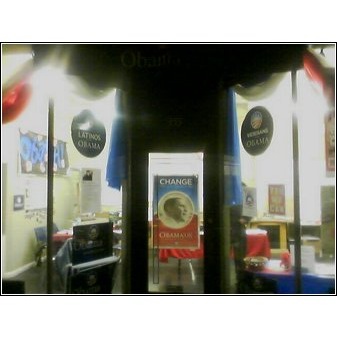
I spent the day campaigning with the Obama team in Easton, Pennsylvania, one of thee three cities that make up the Lehigh Valley. Obama’s campaign has been moving staff into PA — making sure this state, which often boasts results closer than polls predicted, stays in the Democratic column.
I wasn’t here with Drinking Liberally; I was here with the Krebs family, and scores of other New Yorkers who bused in to knock on doors. When the sun went down, we didn’t go home — we went to the phones — in the sweet and photogenic storefront that hosts Obama’s Easton operation.
What keeps this place going is a core of team members — staff, fulltime volunteers, a 13-year-old kid that made calls next to me — and, the secret to every good operation, plenty of food.
Lincoln, NE, is AWESOME. The best moment was at the state fair watching a beauty contest where one of the speakers talked about her platform as ‘eating right and being healthy’ right next to booths like the one above.
This is what labor day looks like for lots of people here.
I’ve been asking around about why Nebraska is Republican. The most common response is ‘tradition’, and while there is a strong religious element, this is not a state where Huckabee was strong or Ron Paul had resonance. Nebraska has remarkable wind resources, and unlike Oklahoma, very little oil, so it’s a net energy consumer. With high energy costs, this is killing the bedroom communities of 800 sprinkled throughout the state, and causing people to move into more urban areas. My guess is that ‘tradition’ has a lot to do with a heavily subsidized rural and military economy undergirded by historically cheap energy.
Obama is going to run much stronger here than Kerry did, and since Nebraska splits its electoral votes, he may come out and take one or two votes here. If the campaign chooses to organize here, Scott Kleeb could really benefit.
I’m heading over to Scott Kleeb’s tailgate before the opening game of the season for the University of Nebraska Cornhusker’s football team. I spent a bunch of time at the state fair, and there are more pictures coming, including the state’s largest pig and some conversations and interviews about renewable energy. I’m driving through Lincoln on the way to Minneapolis for the RNC Convention.
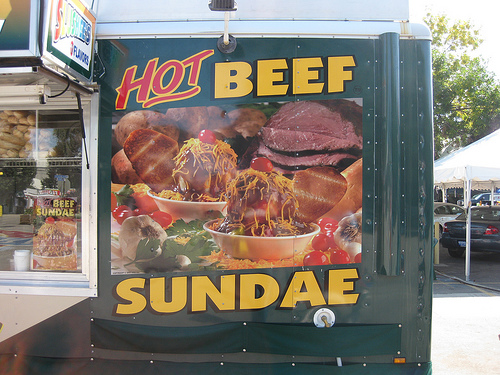
Here’s what you’re missing.
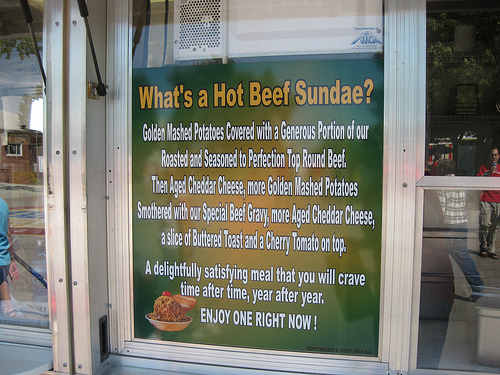
And here’s a description.
Finally, here’s beefman.
I’m staying with Marvin Ammori, the lawyer behind the Comcast decision at the FCC and a law professor as of a week ago in Lincoln, NE. If you’re in town, let him know.


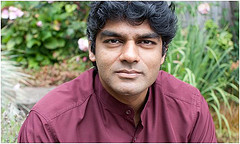 Bio: Raj Patel has degrees from the University of Oxford, the London School of Economics and Cornell University, has worked for the World Bank and WTO, and protested against them around the world. He has testified about the causes of the global food crisis to the US House Financial Services Committee and is an Advisor to the United Nations Special Rapporteur on the Right to Food. In addition to numerous scholarly publications, he regularly writes for The Guardian, and has contributed to the LA Times, NYTimes.com, The San Francisco Chronicle, The Mail on Sunday, and The Observer. He is the author of Stuffed and Starved:
 A recent
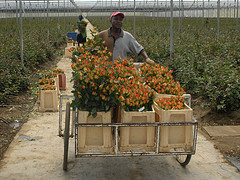 As Iceland’s erupting volcano strands thousands of air travelers across Europe and worldwide, a less publicized but arguably more costly catastrophe is mounting 15,000 miles away: piles of gourmet produce and cut flowers, some of Kenya’s chief exports, are rotting in limbo. Meant to be shipped to upscale grocery stores throughout Europe, lilies, roses, carnations, carrots, onions, baby sweet corn, and sugar snap peas are going bad in heaps, on the vine, and in the ground because airport warehouses are already full and there’s no local market for the expensive produce in a country where half the population lives on less than a dollar a day.