There's a lot of rigidity visible in how many people's thinking has remained remarkably unaffected by the virtually unprecedented behavior of the GOP over the past year-plus. The rigidity itself would make an interesting topic to focus on, but it's more like the appetizer as far as I'm concerned, and I want to head straight for the entree: What people should have learned by now about liberals vs. conservatives, the left vs. the right. I've written about this before, how the right/conservatives see politics as war, while the left/liberals see politics as problem-solving. But I'm ready to tackle it again.
To do so, I'd like to step back a bit and take a look at really macro-history, courtesy of Tyler Cowen at Marginal Revolutiopn, in a mid-week post, "Why did it take so long for humans to have the Industrial Revolution?" It wasn't his purpose to answer the question about the origins of left/right attitudes towards politics for us, but he did so, whether he realized it or not. Here's the crux of the matter:
extended periods of economic growth require that technologies of defense outweigh technologies of predation. They may also require that the successful defender, at the same time, has good enough technology to predate someone else and accumulate a sizable surplus. Parts of Europe took a good deal from the New World and this may have mattered a good deal.
Building a strong enough state to protect markets from other states is very hard to do; at the same time the built state has to avoid crushing those markets itself. That's a very delicate balance
Of course other things are important. Cowen also cites Britain's geography, and the influence of Christianity, especially as it evolved into Protestantism, some commentators cited the Enlightenment, which Cowen rightly notes came too late to explain how it got started, but is not so far-fetched if one sees it as the tail end of a secularizing, empiricizing and rationalizing triple-play: the Renaissance, the Reformation and the Enlightenment. And, of course, the start of the modern information age via the printing press also gets noted in comments.
All these "secondary" explanations are importatnt, of course, but they're secondary in the sense that if predation could not be kept relatively at bay for long enough, none of them would have made a difference. It was the core power dynamic in the passage I quoted above that created the opportunity space in which the other factors could take hold. Without them, the Industrial Revolution wouldn't have happened. But with the core dynamic in place for long enough, it seems arguable that sooner or later good enough social/institutional factors would have enabled the start of the Industrial Revolution.
What's this got to do with left & right, liberal & conservative, you ask? Well, simple: the aristocracy is the core of the right, and it's based on two things: predation and inheritence. The European aristocracy is Europe's warrior class, and their values, outlook, social practices and habits define what it means to be conservative. (This is strongly reflected in the American South as well.) Of course, they aren't alone. But they're at the very core, along with the institutions they have long controlled--most notably, the Catholic Church.
Liberalism primarily evolved out of the city-based "middle classes", based in trade, small-manufacture and the professions--the bourgeoisie, although skilled workers (Tom Paine, anyone?) and even freed slaves (Frederick Douglass) played a part as well. In turn, socialism/social democracy evolved primarily out of the working class, although disaffected members of the bourgeoisie (Marx & Engels, anyone?) played a significant role as well.
The Marxist method of dialectical materialism highlighted the tendency for old forms to persist in new ones, in altered forms via the dynamic of thesis-antithesis-synthesis, so there was sensitivity to the fact that the liberal bourgeoisie had more in common with the aristocracy than it generally realized. (Particularly when it took over the functions of running the state, setting up empires, running slave trades, etc.) But in fact, this analytically method actually understates the degree to which all sides tend to reflect one another in various ways, nor does it adequately account for similarities between the proletariat and the aristocracy, such as a tendency toward embodied forms of reason, and a more conflictual view of politics. Still, that does not negate the fact of profound differences in the basic logic of different social groups, nor the fact that generally speaking proletarian politics are to the left of bourgeois politics.
Things got quite a bit more mixed up in America, what with the lack of a national aristocracy, the presence of both an indigenous population to be predated and the imported slave population as a product of predation, and the post-Civil War emergence of monopoly capitalists whose essential logic was much more predatory than earlier capitalists had been, as well as the complex politics of race, ethnicity and region. But the last half century has been a period in which America's political parties--and its politics more generally--has become more aligned along traditional left/right divides--though some new forms were developed to facilitate this.
There has been a lot of talk lately about bipartisanship, particularly with respect to the healthcare bill. Paul Krugman in the New York Times recently described how bipartisanship is impossible because moderate Republicans have been driven out of the Republican party. I'd like to take the analysis a step further.
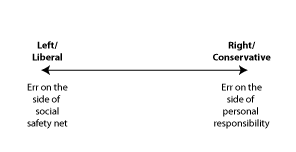
When we talk about the political spectrum, we usually talk about it as though it is a line with a left and a right, like this:
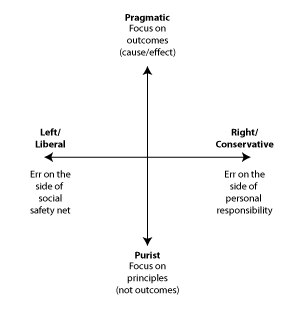
But that's inadequate to describe a lot of the political dynamics that are playing out. There's another axis perpendicular to the first that's become very important recently, which I have been referring to in conversations as the cause-effect axis:
Bipartisanship at the federal level is impossible in any meaningful way right now because there are almost no elected Republicans in the upper right quadrant.
I saw this excellent entry over at Docudharma and just HAD to share. Specifically, I want to hightlight a couple of paragraphs, because they relate very much to how the left has been thoroughly brainwashed by the right into adopting a permanently defensive, always-ask-for-crumbs mindset.
If you can change the way people THINK about an issue you can...and Rove did...change the way people talk about it and act on it. And it worked.
...
Somewhere in the back of our mind a nagging little voice cries out to us..."What will the Republicans think."
"How will the Republicans react?"
And the meaning of that voice is...."How can we PRE-compromise to the Republicans?"
In the Dem politicians mind, that translates into mental, almost unthought about, nearly unconscious phrases like... We have to GIVE THIS to the Republicans or they will be mad."
In bloggers minds that translates into mental, almost unthought about, nearly unconscious phrases like.... "We can't have Single Payer or a strong Public Option."
"We can't call for an end in Afghanistan."
"We have to compromise on Coal."
"We have to use the (demonizing) phrase illegal alien."
And of course the worst one, the grand daddy of them all, used by both the Polilticians and the Bloggers.....
"We don't have the votes."
When Mr. Bowers urges people here to throw everything we have into pushing a "public option" that really won't do the job of reforming health care and certainly won't lead to anything like single-payer, or when Mr. Rosenberg harps on the evils of the sellout Democratic Party yet always steps up to beat down any notion of actually leaving the Republican-wannabes to their political party of choice, what are they doing if not writing from the very frame of mind right-wingers want them to?
It's worth pondering. Anyway, read the full entry. It's quite eye-opening, for those willing to have their eyes opened.
There have been, and will be posts here on openleft, that call for real pressure, strong pressure, on the drive to 'reform' our healthcare system, and what that 'reform' should be.
But there have been no diaries, the frontpage thrust of the debate here at openleft is on the economy, the debates and calls to action, such as the necessary calls to primary those who stand ion the way on necessary legistation are on jobs and laws. There are calls to organize around accuracy in reporting, the history of progressives and Keysian economic plans, calls to reinstate civil rights protection and a threatening survielance society.
But the debate on healthcare is lacking.
That is a shame. This is the time for 'economic, jobs and worker rights progressives' to listen closely to what 'health progressives' are saying, have been saying, will be saying louder and louder in the months and years to come.
The opportunity, the responsibility, right now to act desicively is greater than at any other time in our history. The ongoing lurch of history will beging to have turbulence, the debates about other significant issues will heat up, the situations in other crisis will press for attention. Right NOW is the time.
As OpenLefties know, many progressives are comparing the current economic situation to the 1930s. While the hardships of this recession do not (yet) compare with what our country faced in the Great Depression, there is no question that these are tough times.
The idea that we are reliving the Depression or something like it is part of a larger argument that the U.S. is undergoing a leftward political realignment similar to that of the '30s. The hope is that the Democratic Party will rediscover its New Deal heritage and a new progressive coalition will come together around issues of health care, income inequality, corporate power, etc.
However, even if we assume that Barack Obama and his allies are potential New Dealers with good progressive instincts (and I don't assume anything of the sort), we should recognize that the political landscape of today is missing many of the forces and actors that made the Roosevelt era so ripe for change.
In the 1930s, the possibility that American society would be upended by a genuine social revolution, while probably very remote, was a real fear of some people. As FDR put it: "I was convinced we'd have a revolution in [the] US and I decided to be its leader and prevent it. I'm a rich man too and have run with your kind of people. I decided half a loaf was better than none - a half loaf for me and a half loaf for you and no revolution." Roosevelt was half-bullshitting as politicians always do, but there was some truth to that statement.
Consider the times:
In those years, Huey Long, a terrifyingly ambitious populist from alligator-haunted Louisiana, had the political establishment (and many on the left) shitting bricks with his crusade to radically restructure the American economy.
During this same period, important sectors of the labor movement advanced an explicitly anti-capitalist line. Also, many prominent artists and intellectuals affiliated with the Communist Party, or with Trotskyism, or with the Socialist Party of Norman Thomas.
Left-wing newspapers developed respectable circulations and wide appeal, with sports pages, comics and all. Homeless people, tenants, farmers and other burdened groups organized themselves into associations and managed to cause considerable trouble.
Today we have to ask ourselves, where is our radical labor movement? Where is our EPIC? Where is our Farmer Labor Party? Where is our Daily Worker? Where is our Huey Long?
Maybe the social conditions of this economic downturn will produce similar anti-systemic left/populist movements, but right now I don't see anybody arguing for anything beyond the mild liberalism of MoveOn. I'm all for MoveOn and we'd be lucky to get the MoveOn agenda realized, but I believe progressive politics is the art of backing up maximalist demands with credible threats ... and MoveOn isn't nearly scary or threatening enough for the task at hand.
Last week, John Nichols, Washington correspondent of The Nation, published How to Push Obama in The Progressive.
Nichols recalls how he first covered Obama in the mid-1990s when he ran for the Illinois state senate as a candidate endorsed by the labor-left New Party. Nichols affirms that Obama self-identifies as a progressive, and quotes him:
I am somebody who is no doubt progressive. I believe in a tax code that we need to make more fair. I believe in universal health care. I believe in making college affordable. I believe in paying our teachers more money. I believe in early childhood education. I believe in a whole lot of things that make me progressive.
According to Nichols, Obama knows 'the specifics' of 'the left-labor-liberal-progressive agenda,' but is cautious, 'because knowing the ideals and values of the left is not the same as practicing them,' which Obama certainly hasn't.
So here is Nichols' main recommendation of how 'progressives' should 'push' Obama to the left:
The way to influence Obama and his Administration is to speak not so much to him as to America. Get out ahead of the new President, and of his spin-drive communications team. Highlight the right appointees and the right responses to deal with the challenges that matter most. Don't just critique, but rather propose. Advance big ideas and organize on their behalf; identify allies in federal agencies, especially in Congress, and work with them to dial up the pressure for progress. Don't expect Obama or his aides to do the left thing. Indeed, take a lesson from right wing pressure groups in their dealings with Republican administrations and recognize that it is always better to build the bandwagon than to jump on board one that is crafted with the tools of compromise.
Smart groups and individuals are already at it. [...]
The examples he gives are critiques of the bailout, and advocacy for civil liberties and single-payer health care.
Now, unfortunately, but rather predictably, this is really nothing new, because the Left has been criticizing policies and advocating for alternative policies for decades, with very little success.
I agree with most of what both Mike Lux and Paul Rosenberg have recently written (How We Messed Up and NOT How We Messed Up). And I hope I can add to the discussion by coming at it from a slightly different angle, that of a stone (and in my day stoned) leftist who's run the gamut (not necessarily in this order) from protesting university dorm rules to fighting the war to the Summer of Love to wild in the streets to Peace & Freedom Party to union organizer to New Alliance Party petitioner to rent control tenant activist to welfare advocate to grumpy old (58) curmudgeon who labels himself an independent Democrat, and many stops in-between. And whose first vote ever was for George McGovern.
My main quarrel with Lux isn't that we messed up, but the implication that if we hadn't messed up, we could have won. By winning, I mean, could progressives have taken over the Democratic Party and used it as an effective engine for lasting social change.
Hear that last phrase, "lasting social change." Sounds archaic, doesn't it? Shockingly idealistic. Perhaps even pathetic. To some of us it meant participatory democracy, for a few the dictatorship of the proletariat (the truly archaic!), to others the completion of the New Deal and the Great Society, or simply erasing poverty and racism. And don't forget the Age of Aquarius. The point is that we all had some kind of vision of a society transformed, however much those visions varied from person-to-person and day-to-day.