Is the conservative approach to job creation as deluded as attacking Iraq in response to 9/11? Or is it even more deluded? Either way, it's conceptually similar, in that rationale offered is an excuse, not a reason. The neocons wanted a new Cold War, and in "Rebuilding America's Defenses" they frankly admitted that they needed a "new Pearl Harbor" (p. 63) to get public opinion stampeded into supporting them. On the economic side, Naomi Klein wrote a whole book, The Shock Doctrine about how the "give the rich people all your money" scam works. (Put people into a total panic, then hit them with an avalanche of pre-fab theories telling them "there is no alternative.")
But most particularly on job creation--and comparing the two issues that are up right now: millionaires tax cuts and unemployment insurance--the evidence is overwhelmingly against conservatives as this CBO chart (page 11, slightly modified for visual purposes) clearly shows (unemployment insurance at the top, income tax cuts at the bottom, about 1/6th as effective):
Last night, Rachel Maddow had a real economist on to refute this nonsense (although Rachel holds up a different, earlier CBO document, that has the same data in a table, not a chart):
Once again, that surreal clip from John Shaddeg's interview with Mike Barnicle went like this:
Extended unemployment benefits are about to run out today. If al Qaeda really wanted to hit America where it hurts, this is what they'd do. But there's no need, since the GOP is poised to do it for them.
"We understand the fiscal concerns that arise when debating a continuation of unemployment insurance programs. However, a broad spectrum of economists has stated that these benefits have a significant stimulative effect and a greater impact on gross domestic product than most other federal programs. In fact, the Economic Policy Institute has stated that an extension of federally funded extended benefits would increase gross domestic product by 0.7 percent and save or create the full-time equivalent of 723,000 jobs. A U.S. Department of Labor report, commissioned during the Bush Administration, has found that unemployment benefits during the most recent recession saved 1.6 million jobs per quarter, lowered the unemployment rate by 1.2 percentage points, and reduced the decline in gross domestic product by 18.3 percent. Based on this information, now is not the time to end federally funded unemployment benefits.
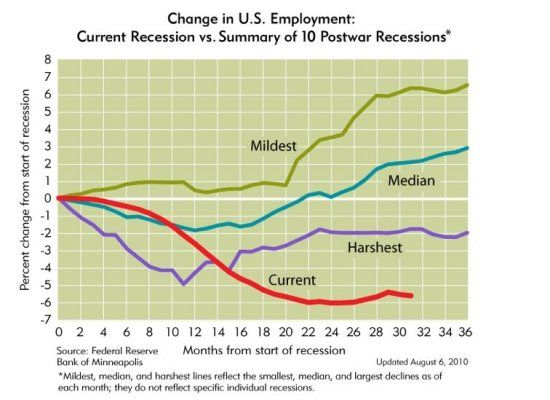
Conservatives like to pretend that all this unemployment is due to a sudden wave of laziness among workers. Or, alternatively, it's because marginal taxes on millionaires has created "uncertainty", though how that's supposed to affect job creation they never bother to spell out. But the reality is quite simple: This is the worst recession since the Great Depression, and employment gains in recoveries after recessions have grown increasingly slow over time.
Tens of thousands of Americans rallied for jobs and justice at the Lincoln Memorial in Washington, D.C. on Saturday. Organizers say that 175,000 people turned out for the One Nation Working Together rally, which was organized by labor unions, the NAACP, and other progressive groups. In an interview with GritTV's Laura Flanders, AFL-CIO president Richard Trumka, a leader of the One Nation coalition, summed up the agenda: "Jobs, jobs, and more jobs."
America isn't working
In total, 8 million jobs have been lost in this recession and 2.5 million homes have been repossessed. According to the official figures, about 10% of Americans are unemployed. The true number may be much higher because the official stats don't count those who have given up looking for work. In AlterNet, NAACP President Benjamin Todd Jealous, another featured speaker at One Nation, points out that the black unemployment rate is nearly twice that of whites. Another 11 million Americans are underemployed, according Trumka.
No end in sight
An already bleak job market is about to get even bleaker. Last week, Senate Republicans scuttled a popular emergency fund to create jobs and an extension of long-term unemployment insurance benefits, as Andy Kroll reports in Mother Jones.
Steve Benen of the Washington Monthly offers more details on the now-defunct job creation program known as the Temporary Assistance for Needy Families (TANF) emergency fund. The fund provided cash to create jobs in the public and private sectors. Over 240,000 people in 32 states and the District of Columbia worked at jobs created with TANF subsidies. Last week, Senate Democrats lost their fight to extend the program for another 3 months. With the TANF money gone, layoffs will soon follow.
The Department of Labor will release the its monthly unemployment statistics on Friday. One group of independent analysts predicts that September's unemployment rate will be higher than the previous month, according to Brian Beutler of Talking Points Memo. Unemployment rose from 9.6% in July to 9.7% in August and experts surveyed by Bloomberg News expect the trend to continue. It's doubtful that the economy produced enough new jobs to make up for all the census workers whose temporary jobs ended.
Job skills for America
On the bright side, President Barack Obama is scheduled to unveil a new job training program this week, Annie Lowrey reports in The Michigan Messenger. The program is called Skills for America's Future. The goal of the project is to encourage partnerships between community colleges and corporations. Colleges and companies will work together to identify areas of rapid job growth and train students to fill those jobs. So far, five companies have agreed to participate in the program, including the Gap., Accenture, United Technologies, PG&E and McDonald's.
Lowrey argues that this kind of training program will do little to help unemployment in the short term. Right now, companies aren't hiring because there's an economy-wide lack of demand, not because they can't fill positions for lack of trained workers. Demand is low because unemployment is high. Quite simply, people buy less when they don't have jobs, or fear that they will lose their jobs. It's a Catch-22. The jobs won't come back because not enough people have jobs.
Food stamps are stimulus
At the most basic level, an economic stimulus package is designed to break the no jobs/no demand/no jobs impasse by injecting large amounts of cash into the economy. Extending unemployment benefits makes for very effective stimulus because the unemployed typically spend their money quickly. Food stamps are another very efficient stimulus because recipients redeem them right away. To give you some indication of how quickly, consider the Wal-Mart at Midnight effect, which Lowrey discusses in the Washington Independent.
Wal-Mart managers are noticing that increasing numbers of customers are buying staples like bread, milk, and baby formula at midnight on the first of the month. That's because state governments directly deposit welfare and food stamp benefits into debit accounts at midnight. Wal-Mart says it brings in extra staff to keep up with the influx of customers during this period.
By contrast, tax cuts are an inefficient stimulus, especially if the cuts go to people who are already wealthy. In tough times, people who already have everything they need may prefer to save their extra money instead of blowing it on luxuries. Rich people will not throng Best Buy at midnight on tax refund day, no matter how big their checks are.
The high cost of economic inequality
It would be nice to think that unemployment is part of a cyclical downturn, but there is mounting evidence that short-term unemployment is a symptom of a deeper problem: pervasive and growing inequality. Sam Petulla of the American Prospect interviews economist Jacob Hacker and political scientist Paul Pierson about their new book, Winner Take All Politics: How Washington Made the Rich Richer and Turned its Back on the Middle Class.
The authors note that the U.S. has greater inequality than other industrialized countries. Since the 1970s, the richest Americans have gotten much richer while the rest of us lagged further behind. The authors found that almost 40% of household income gains from 1979-2007 went to the richest 1% of households. The trend is accelerating: the top 1% of households pocketed over half of the economic gains of the 2000s. Hacker and Pierson blame tax cuts for the wealth, lax financial regulations that allow the wealthy to rake in unprecedented profits, and stagnating middle class wages for the widening gap between the ultra-rich and the rest of society.
This brings us back to the old demand/jobs paradox. Contrary to the platitudes of trickledown economics, shoveling an ever greater share of society's resources to the ultra-rich doesn't make everyone else better off. Shocking, right?
Right wing economists say that letting the ultra-rich accumulate still more wealth is good for the economy as a whole because the rich have more money to invest in businesses, which are the main source of jobs. The ultra-rich aren't stupid, however. They aren't going to start businesses unless they foresee demand for goods and services; and everyone knows that demand is flat because there are no jobs. Trying to stimulate the economy by making the rich richer is like shoving money into a black hole. The tried and true way to end a recession is to create jobs and provide social services for people who need the money enough to spend it.
This post features links to the best independent, progressive reporting about the economy by members of The Media Consortium. It is free to reprint. Visit the Audit for a complete list of articles on economic issues, or follow us on Twitter. And for the best progressive reporting on critical economy, environment, health care and immigration issues, check out The Mulch, The Pulse and The Diaspora. This is a project of The Media Consortium, a network of leading independent media outlets.
Ordinarily, a bad economy is bad for the party in power. This is far and away the greatest factor working against Democrats in the mid-terms. But the GOP's outright hostility to the unemployed may turn out to be a key factor in muting that effect.
It's a bit strange how things are suddenly moving quickly on this front after uninsurance benefits finally passed the Senate. This morning, Greg Sargent wrote a post, "The 'Let Them Eat Want Ads' Caucus", which began:
Let's call it the "Let Them Eat Want Ads" Caucus -- those candidates and public officials who argue that unemployment benefits are problematic because they discourage people from seeking jobs.
And let's add another Republican to that caucus: Candidate Michele Rollins, who's running for Mike Castle's open House seat in Delaware.
Rollins, who's running in a contested race against green technology exec John Carney, was asked by a constituent if she would have voted to extend unemployment benefits. She suggested she wouldn't, claiming that "for someone who hasn't worked in two years" it's "pretty hard to get energized to go back and look for a job."
In followup, Rollins denied blaming the unemployed for being lazy, but then did a 180 (probably without realizing it--these folks aren't terribly bright):
But Rollins did tell her constituent that giving people benefits risks ensuring that people "will continue to do nothing." And she's only the latest to make this claim. Sharron Angle suggested that the unemployed were getting "spoiled" by benefits, though she later backtracked. Senators Richard Burr and GOP Senate candidate Ron Johnson, who's challenging Russ Feingold, have also argued that unemployment benefits discourage job-seeking. If I've missed others, let me know
Then this afternoon, Greg posted another installment. But before getting into it, I want to share a video--which Greg linked to--of a presentation by economist Raj Chetty showing that unemployment benefits are not a disincentive to finding work. It's true that they look like a disincentive for low-wage workers, Chetty shows, but this effect goes away for those with more savings. The best explanation: it's not a disincentive effect, but a cash-on-hand effect, which moves people somewhat out of panic mode, so that they do things like spend more time with their kids. And to prove his point, he looks at foreign data showing that lump-sum cash payments (which by definition don't continue over time) have the same sort of effect:
Congress finally authorized an extension of unemployment benefits on Wednesday, providing a critical lifeline to families across the country and an absolutely essential boost to the economy.
About a week ago, last Thursday to be sure, a number of media outlets were reporting on a Labor Department report that said new weekly claims for unemployment fallen by 3,000 to a seasonally adjusted 456,000. Most of those same stories included details that total unemployment benefit rolls had fallen by 255,000 to 4.5 million.
(earlier version Cross posted at tpm/and my blog codylyonblogolater)
Hello. If you are a regular reader of this blog then you know that I am openly and proudly Liberal Progressive. Most of the time the things I write are both influenced by politics and intended to advocate for a particular way of thinking on current events. However today although I easily could, I'm not going to do that. The reason being is that the issue I'm going to present is in my opinion much, much too important to play politics with.
The other day Senate majority leader Harry Reid, in attempting to make an emotional appeal on behalf of a bill to extend unemployment benefits said the following,
"Men when they're out of work tend to become abusive. I met with some people while I was home dealing with domestic abuse. It has gotten out of hand. Why? Men don't have jobs. Women don't have jobs either, but women aren't abusive, most of the time. Men, when they're out of work, tend to become abusive. Our domestic crisis shelters in Nevada are jammed."
His concerns are valid and justifiable. But in just one sentence he downplayed, in truth dismissed the experiences of a number of men who are believed to be in the millions. These are men who are survivors of partner abuse.
Through inaction and timid legislative negotiations, Congress just keeps letting the U.S. sink deeper and deeper into the economic abyss. Last week, Congress denied relief to the jobless and is currently poised to undercut a proposal that would rein in predatory lending. With unemployment out of control and banks pillaging citizens' pocketbooks at every turn, the economy is in dire need of serious financial reform and a major jobs package.
More than one million have lost unemployment benefits
As James Ridgeway emphasizes for Mother Jones, over a million people receiving unemployment benefits ran out of financial rope on March 1 thanks to Sen. Jim Bunning's (R-KY) self-righteousness. As a result of bizarre Senate procedural rules, Bunning's sole "no" vote was enough to stop a bill that would have extended unemployment benefits for those who are out of work. Of course, Bunning had plenty of moral support from his fellow Republicans. Ridgeway highlights a Think Progress post on Rep. Dean Heller's (R-NV) preposterous argument that it is time for the government to cut off unemployment benefits, since there are so many bums.
"What makes Heller's statement really stupid, of course, is that people could become hobos if Congress doesn't extend unemployment benefits, rather than if they do," Ridgeway writes. "Modest as they are, these weekly benefits are what's keeping thousands-and perhaps millions-of families out of poverty."
As Brian Beutler notes for Talking Points Memo, Bunning's economic insanity also triggered a 21% cut in the fees doctors receive for treating Medicare patients. That's a big "Screw you!" to seniors.
What happens when unemployment benefits dry up?
The degree of personal crisis attached to unemployment is also important. We're talking about access to basic necessities. As Roger Bybee notes for Working In These Times, when a family runs out of unemployment benefits, the result is an absolute personal catastrophe in which there is simply no money left to buy food, pay rent, or meet electricity bills.
Yet when a major financial institution finds itself on the verge of collapse, the government is quick to come to the rescue. In addition to the one million people ran out of benefits on March 1, four million more are slated to run out by June-that's roughly the combined populations of Los Angeles and Dallas. This is a tremendous national crisis. Here's Bybee:
"There is plenty of bipartisan compassion in Congress when it comes to bailing out the wealthy and their banks. But when it comes to spending federal money to bail out folks ... with unemployment compensation and a major jobs program, a bi-partisan consensus forms among conservatives in both parties eager to show 'fiscal discipline.'"
As Nobel laureate economist Joseph Stiglitz emphasizes in an interview at AlterNet, the jobs crisis is so severe that the government needs to go much further than simply extending existing unemployment benefits. At minimum, it also needs to send a major package of fiscal aid to states on the order of $200 billion to allow states to hire teachers and cops, as well as prevent further layoffs.
Making the jobs bill accessible to all
While a new jobs bill is critical, it's important to make sure everyone has access to its efforts, as Aaron Glantz explains for The Progressive. The economic stimulus bill that President Barack Obama signed into law last year has helped keep the economy from falling off a cliff, but it's overwhelmingly neglected communities of color. The unemployment rate for blacks is 16.5%, nearly the double the 8.7% rate for whites, while Latinos face an unemployment rate 50% higher than whites. Not all of that disparity can be blamed on the stimulus, but the federal contracts awarded for new jobs projects overwhelmingly went to white-owned firms. We have to make sure that the funds Congress dedicates to unemployment relief are distributed fairly.
Save the Consumer Financial Protection Agency
After watching the government hurl trillions of dollars at faltering banks, it's obvious that major financial reform is urgently needed. And one of the most important aspects of that reform is a new regulatory agency that defends consumers, not just bank balance sheets. As Tim Fernholz argues for The American Prospect:
"Shoring up our financial system to avoid new disasters remains popular with the public but only if it represents real reform. ...That means closing loopholes and making clear that this bill has what it takes to protect average citizens as well as restricting banks' bad behavior."
And yet astoundingly, Sen. Chris Dodd (D-CT), the current Democratic leader of financial reform negotiations in the Senate, appears ready to drop Obama's proposal to create an independent Consumer Financial Protection Agency (CFPA).
Instead, Dodd would house the regulator under the Treasury Department, and give the existing, failed bank regulators effective veto power over the CFPA's moves. It's a head-fake: We create a new regulator, but are instead giving that power to the same failed agencies who allowed the banks to pillage our pocketbooks, our retirement savings and our home values.
Failed negotiations with the GOP
This is supposedly all part of a set of negotiations with Republicans, but they aren't really negotiating in any clear sense. Negotiating means going through some process of give-and-take. Right now, Republicans are just seeing how far Democrats will bend, and so far, there has been no limit. Ferhnolz is right. Voting for the banks and against taxpayers and consumers will be a very bitter pill for Republicans to swallow. Dodd and the Democrats need to make them do it instead of caving to pressure and allowing Republicans to vote for a weak bill that doesn't protect the public from banker excess. Make the Republicans vote for real reform, or face the consequences at the polls for voting against it.
The public shame that is currently being heaped upon Bunning should prove that point. The American public wants jobs and financial reform. They want to go back to work and make sure that the bankers who tanked the economy can't keep getting rich by hijacking their savings. Woe unto the politician who opposes that.
This post features links to the best independent, progressive reporting about the economy by members of The Media Consortium. It is free to reprint. Visit the Audit for a complete list of articles on economic issues, or follow us on Twitter. And for the best progressive reporting on critical economy, environment, health care and immigration issues, check out The Mulch, The Pulse and The Diaspora. This is a project of The Media Consortium, a network of leading independent media outlets.
On Friday, we learned that the U.S. unemployment rate officially broke 10% for the first time since the early Reagan years. This is about as bad as it gets for a modern, developed economy. No economic force takes a heavier toll on a society than rampant joblessness, and few personal setbacks take a deeper psychological toll than being out of a job for months on end. If Congress and President Obama don't do something to create jobs fast, both are going to pay a hefty political price when next year's mid-term elections roll around.
So how bad is it? In October, the economy shed 190,000 jobs and the unemployment rate jumped from 9.8% to 10.2%. That percentage is the most optimistic reading of the labor market in Friday's report. If you take people who want full-time jobs but are settling for part-time work, then add those who have simply given up on finding a job, the rate is a massive 17.5%.
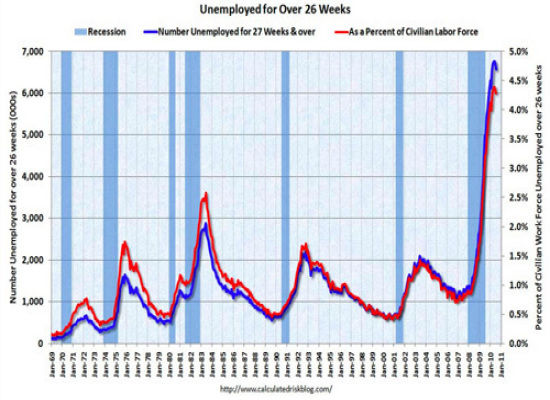
The problem is not that either Obama or Congress have failed to act on the problem, but rather that they have not done enough. When Congress was moving on Obama's $787 billion economic stimulus package back in February, we were shedding upwards of 700,000 jobs a month. So the stimulus package has worked-it's probably helped keep unemployment from jumping to 12% or 13%. But this is cold comfort to the nation's 15.7 million unemployed, 5.6 million of whom have been out of a job for more than six months.
As Robert Reich notes for Salon, Obama's economic advisers dramatically underestimated how bad things would get when they crafted the stimulus package. As a result, the package was too small and unemployment has remained high. Obama needs to go back to Congress and demand more economic relief funding. Republicans will continue to whine about government spending to excuse their obstructionism, of course, and conservative Democrats will probably start sweating, too-Sen. Ben Nelson (D-NE) helped cut back the original stimulus bill in February to help boost his "centrist" credentials. This of course had nothing to do with economics or policy. Government spending is what saves the economy in a recession. In a downturn as severe as this one, it takes a lot of spending to turn things around.
But as Reich notes, Nelson and his cohorts will have a lot more to worry about in the 2010 elections if the economy doesn't actually improve over the next year. And few economists think it will. The Congressional Budget Office, which is run by a conservative economist named Douglas Elmendorf, projects an average unemployment rate of over 10% in 2010. That's worse than this year. Democrats from swing districts need to support economic relief packages. Continued economic malaise will severely hurt them at the polls.
Congress finally took some action on joblessness on Thursday, voting to extend unemployment benefits for an additional 14 weeks. If we want the economy to recover, we need people to spend money, but if people aren't working, they don't have any money to spend. So the government cuts people checks to help them get by and stimulate a demand for goods and services. Even most conservative economists thinks this is a good idea.
But as Kevin Drum notes for Mother Jones, the soundness of the policy did nothing to prevent Republicans from fighting the effort to extend benefits tooth-and-nail. The bill had to overcome three-that's right, three-filibusters in the Senate from Republicans, who held up the bill for weeks for no apparent reason. In a blog post for The Washington Monthly, Steve Benen explains the economic cost of this obstructionism: In the weeks of delay, 200,000 people looking for work stopped receiving benefits.
But extending unemployment benefits will not solve our economic woes. The total program is just $2.4 billion, a drop in the bucket compared to the trillions of dollars the government put up to salvage Wall Street. $2.4 billion is not enough to reverse the unemployment trend. Cutting the checks certainly helps, but as Matthew Rothschild emphasizes for The Progressive, we need an economic policy that actually puts people back to work. We've known for months that the stimulus was too small and watched the labor market continue to deteriorate. We need more than tweaks at the economic margins, we need a robust job creation plan.
As Stephen Franklin notes for Working In These Times, we already know that the recession has created a significant jump in the nation's poverty rate. According to official government statistics, the rate climbed from 12.5% to 13.2% in 2008, the largest increase since 1991. But the National Academy of Science thinks the government statistics are misleading, as they account for rising costs associated with medical care, transportation, child care and different regional living standards, as Franklin notes. Taking these factors into account, the National Academy of Sciences calculates the actual poverty rate to be 15.8%. That's an additional 7 million people living in poverty, for a total of over 47 million. That's more than the entire population of the New York, Los Angeles, Chicago, and Philadelphia metropolitan areas combined. What's worse, we don't have poverty statistics for this year, when the most severe economic damage was been dealt.
Workers are facing tough economic prospects around the world. Writing for The Nation, Kristina Rizga details Latvia's economic turmoil. Just like the US, overexcited bankers in Latvia inflated a massive real estate bubble that took down the entire economy when it burst. But with the bubble burst, much of the country is now out of a job and stuck with a mortgage worth far less than what they paid for it. It's almost exactly the same story we've seen at home.
No domestic economic problem is more pressing than our epic levels of unemployment. We need another round of stimulus to get people working again. If not, we'll see the same public unrest here as in Eastern Europe.
This post features links to the best independent, progressive reporting about the economy by members of The Media Consortium. It is free to reprint. Visit the Audit for a complete list of articles on economic issues, or follow us on Twitter. And for the best progressive reporting on critical economy, environment, health care and immigration issues, check out The Mulch, The Pulse and The Diaspora. This is a project of The Media Consortium, a network of leading independent media outlets.